
Published: June 19, 2026 | Last Updated: May 31, 2026
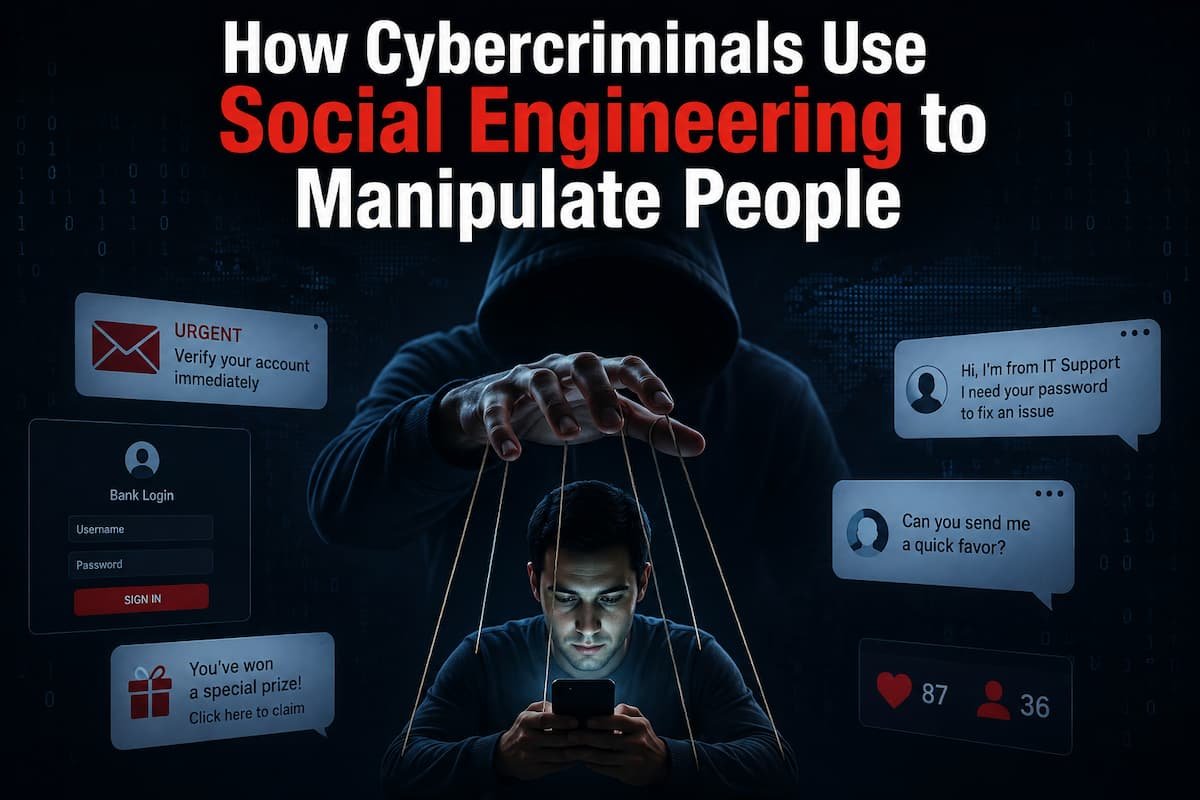
Most people picture hackers as hooded figures typing furiously in dark rooms, breaking through firewalls with complex code. The reality is far less cinematic and far more unsettling. According to Verizon’s 2024 Data Breach Investigations Report, 74% of all breaches involve the human element, including social engineering attacks, errors, or misuse. The weakest link in cybersecurity isn’t the software; it’s us.
What Social Engineering Actually Means
Social engineering is the art of manipulating people into giving up confidential information or performing actions that compromise security. Unlike technical hacking, which exploits software vulnerabilities, social engineering exploits human psychology, our natural tendencies to trust, help, obey authority, or act quickly under pressure.
The term itself comes from the social sciences, where it originally described efforts to influence societal attitudes and behaviors on a large scale. Cybercriminals adapted the concept for individual targeting, turning psychological research into a playbook for theft and fraud.
The Psychological Triggers That Make Us Vulnerable
Understanding why social engineering works requires a brief look at how our brains process social information. We make thousands of snap judgments daily, and attackers exploit the shortcuts our minds take.
| Psychological Principle | How Attackers Exploit It | Common Attack Type |
|---|---|---|
| Authority Bias | People tend to obey figures of authority without question | CEO fraud, fake IT support calls |
| Urgency & Scarcity | Time pressure prevents careful analysis | Fake account suspension warnings, limited-time offers |
| Reciprocity | We feel obligated to return favors | Free software downloads that install malware |
| Social Proof | We follow what others appear to be doing | Fake reviews, “your colleagues already signed” |
| Fear & Intimidation | Threats trigger immediate defensive reactions | IRS impersonation, fake legal threats |
| Curiosity | We want to know what’s hidden or forbidden | “Click to see who viewed your profile” scams |
These aren’t abstract concepts. They’re hardwired into human cognition, developed over millennia to help us navigate social groups efficiently. Attackers know this better than most of us know it ourselves.
The Most Common Social Engineering Tactics in Use Today
While the underlying psychology remains constant, the methods are constantly evolving. Here are the dominant techniques currently threatening individuals and organizations.
Phishing: The Old Reliable
Phishing remains the most prevalent form of social engineering, and for good reason, it works. Attackers send fraudulent communications that appear to come from legitimate sources, typically via email, though SMS (smishing) and voice calls (vishing) are growing rapidly.
Modern phishing has moved far beyond the laughable “Nigerian prince” emails of the early internet. Today’s phishing emails mimic corporate branding with frightening accuracy, use domain names that differ by a single character from legitimate ones, and reference real events or relationships gathered from social media.
Pretexting: Building a Believable Story
Pretexting involves creating a fabricated scenario to obtain information. The attacker establishes credibility through a convincing backstory, then uses that trust to extract data.
A common pretexting scenario involves someone calling an employee and claiming to be from the IT department, conducting a “routine security audit.” They build rapport, mention real colleagues or systems, and eventually ask the employee to verify their password or install a “security update” that is actually malware.
Baiting: The Trap You Walk Into
Baiting plays on curiosity and greed. It might be a USB drive labeled “Confidential—Salary Information” left in a parking lot or a download link promising free software, movies, or games. The moment the victim takes the bait, malware installs itself.
Quid Pro Quo: The Favor Exchange
This technique offers a service or benefit in exchange for information or access. The classic example is a caller offering free technical support in exchange for remote access to the victim’s computer. Once connected, they install ransomware or steal data while “fixing” a non-existent problem.
Tailgating: The Physical Dimension
Not all social engineering happens online. Tailgating involves following an authorized person into a restricted area. The attacker might carry something bulky and ask someone to “hold the door,” or simply walk in with confidence, assuming employees won’t challenge someone who looks like they belong.
Why Social Engineering Is Getting Harder to Spot
Several factors have made modern social engineering attacks significantly more dangerous than their predecessors.
Data Availability: Social media, data breaches, and public records provide attackers with enormous amounts of personal information. When a scammer knows your mother’s maiden name, your recent purchases, and the name of your child’s school, their pretense becomes much harder to penetrate.
AI-Assisted Personalization: Generative AI tools allow criminals to craft highly personalized messages at scale, eliminating the spelling errors and awkward phrasing that once served as red flags. They can also generate convincing deepfake audio and video for vishing attacks.
Remote Work Vulnerabilities: The shift to remote work has dissolved many informal security checks. Employees can’t walk down the hall to verify an unusual email with a colleague. IT support happens through tickets and chat rather than face-to-face interaction, making impersonation easier.
Information Overload: The average office worker receives over 120 emails daily. When people feel overwhelmed, they rely more heavily on mental shortcuts, which creates the very conditions that social engineering thrives on.
Protecting Yourself and Your Organization
Defense against social engineering requires both organizational policies and individual vigilance. No single solution exists, but layered approaches significantly reduce risk.
- Verify independently. If someone requests sensitive information or urgent action, contact them through a known, trusted channel. Please avoid using contact information provided in the suspicious message.
- Implement the “pause protocol.” Urgency is the attacker’s friend. Train yourself and your team to pause and verify whenever a message creates time pressure, even if it appears to come from a CEO or government agency.
- Use multi-factor authentication everywhere. Even if credentials are compromised through social engineering, MFA prevents most unauthorized access. Hardware security keys offer the strongest protection.
- Limit information exposure. Review your social media privacy settings. The less personal information publicly available, the harder you are to target with personalized attacks.
- Establish verification procedures. Organizations should have clear protocols for wire transfers, password resets, and data access requests that cannot be bypassed based on a single email or phone call.
- Conduct regular simulations. Phishing simulation exercises keep employees alert without the consequences of real attacks. However, use them as educational tools, not punishment mechanisms, or you’ll create a culture of fear rather than security awareness.
The Human Element Is Not a Bug
It’s tempting to see human susceptibility to social engineering as a flaw that we should engineer away. This perspective is both inaccurate and counterproductive. Our tendency to trust, cooperate, and respond to authority has enabled human civilization. The problem isn’t that we’re social creatures; it’s that we’ve created environments where social interaction happens without the contextual cues, personal relationships, and accountability mechanisms that historically kept exploitation in check.
The solution isn’t to make people less trusting; it’s to build verification into our systems and teach critical evaluation without creating paranoia. When someone calls claiming to be from your bank, the appropriate response isn’t suspicion of everyone; it’s the simple habit of hanging up and calling the number on your card.
“The only truly secure system is one that is powered off, cast in a block of concrete, and sealed in a lead-lined room with armed guards.” — Gene Spafford, computer security expert
Since we can’t operate that way, we must accept that security is a process of managing risk, not eliminating it. Social engineering awareness is one of the most cost-effective investments in risk management available to both individuals and organizations.
Looking Forward: The Arms Race Continues
As defensive awareness improves, attackers adapt. We’re already seeing the emergence of “vishing” campaigns using AI-generated voices that sound exactly like known colleagues or family members. At least one major corporate fraud case has used deepfake video calls. The technology will only become more accessible and more convincing.
However, the fundamental vulnerability remains unchanged: the human desire to be helpful, to avoid conflict, to comply with authority, and to act quickly when threatened. These traits are valuable and should persist. Our challenge is to build habits and systems that protect us without diminishing the social trust that makes cooperation possible. Criminals will continue to refine their techniques. Our best defense is a combination of healthy skepticism, robust verification procedures, and the understanding that in the digital age, “trust but verify” isn’t cynical advice; it’s essential survival skills.

Robert Chen is a smart home technology consultant and the founder of ClarityTechHub. With over eight years of hands-on experience installing residential solar systems, configuring smart security networks, and optimizing connected home devices, Robert writes from direct practical experience. He has advised more than one hundred homeowners on energy-efficient technology upgrades and regularly tests emerging devices to evaluate real-world performance. All product recommendations and technical guides on ClarityTechHub are based on independent research and firsthand testing.